Quality patient data is the key to unlocking insights and tools central to efficient, effective clinical research — especially in rare, heterogeneous diseases such as Duchenne muscular dystrophy. cTAP unlocks that potential to enable collaborative, curated, non-competitive, best-in-class patient data science. For more than ten years, we have honed our approach to help rare neuromuscular communities come together to prioritize problems and align on an agenda, rally diverse cross-stakeholder input and resources, and take collaborative action where it matters most. The result: faster learning, deeper insights, and fit-for-purpose findings that elevate the bar for all who conduct rare neuromuscular clinical research.
cTAP got our start in Duchenne muscular dystrophy in 2015. The Duchenne field faced a tragically high rate of pivotal trial failures, leaving most of the 300,000 boys and young men with Duchenne muscular dystrophy were without the right treatment. Each patient with Duchenne has his own distinctive longitudinal trajectory of disease progression. Some patients progress rapidly, while others may only reach the same clinical milestones a decade or more later.
A core challenge in designing and analyzing clinical trial and post-marketing data in Duchenne was how to take into account these different rates of disease progression to discern whether a patient is doing well because of a drug or because his disease is slowly progressing and he was going to do well anyway.
cTAP saw the opportunity: With collaboration, the right questions, and the right data science, this heterogeneity should be knowable. And trials that work to get definitive answers for patients should be possible. cTAP got to work.
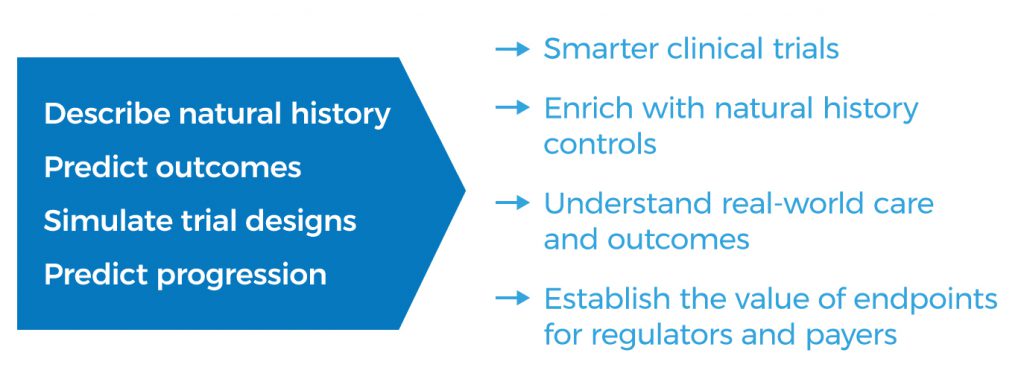
Ten years later, the results are powerful – and still growing. Today, cTAP has:
- characterized and quantified the heterogeneity in longitudinal disease progression that historically has undermined clinical trials in Duchenne
- identified prognostic factors to more than double prognostic accuracy in outcomes over the period of a clinical trial
- established the consistency of progression of outcomes between natural history and placebo arms
- defined quantitative relationships between near term changes in outcomes versus time to longer term clinical milestones
Characterizing heterogeneity of disease progression
Quantitative evidence of underlying structure to differences in disease progression – Clustering of longitudinal trajectories of natural history halves variance.
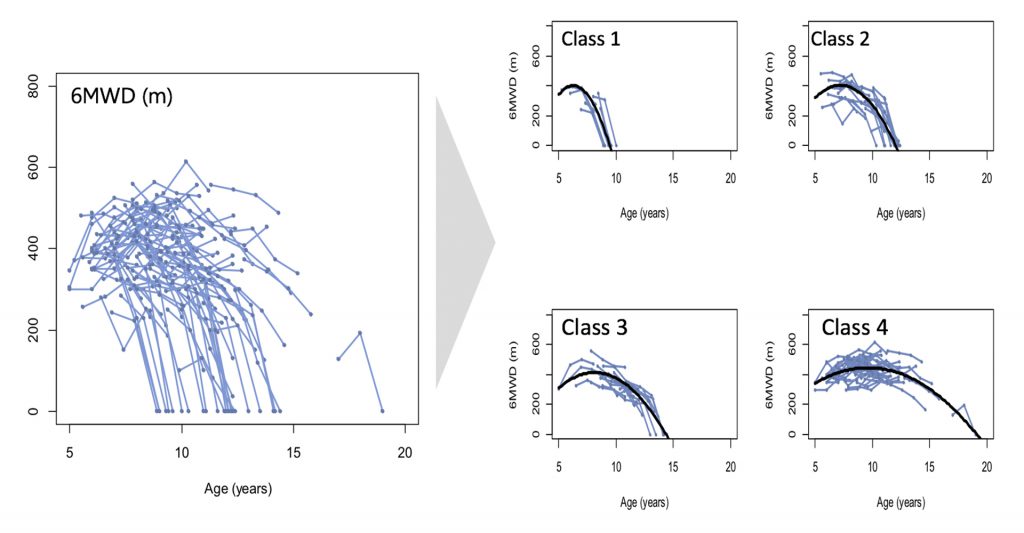
Mercuri EM, Signorovitch JE, Swallow E, Song J, Ward SJ for DMD Italian Group and CollaborativeTrajectory Analysis Project (cTAP) (2016)..Categorizing natural history trajectories of ambulatory function measured by the 6-minute walk distance in patients with Duchenne muscular dystrophy. Neuromuscular Disorders; (26): 576-583
Total sample sizes required to detect a 30 m change in 6MWD
Prognostic factors identified and prognostic models built – more than doubles prognostic power, marked reduction in ‘n’ to power a clinical trial.
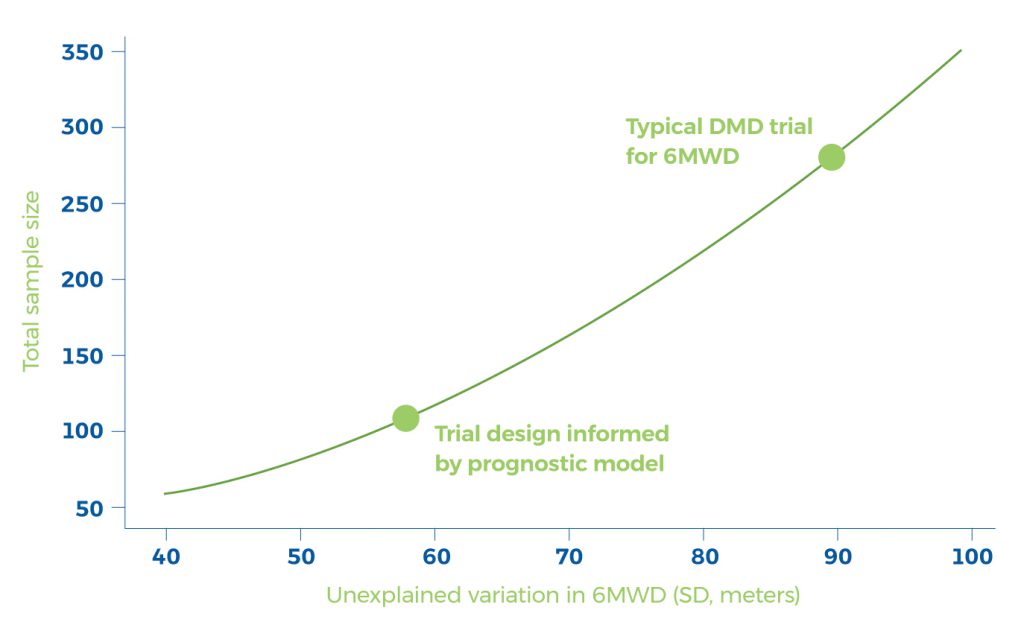
Goemans N, vanden Hauwe M, Signorovitch J, Swallow E, Song J, CollaborativeTrajectory Analysis Project (cTAP) (2016). Individualized Prediction of Changes in 6-MinuteWalk Distance for Patients with Duchenne. Muscular Dystrophy. PLoS ONE 11(10): e0164684